Moving in Vancouver Without a Car: A Complete Guide to Car-Free Moves

Moving in Vancouver Without a Car: A Complete Guide to Car-Free Moves
Not everyone owns a car in Vancouver — and honestly, in a city where a parking spot downtown can cost more than a small mortgage payment, you don't need one. But when it's time to move, the question becomes: how do you move an entire apartment across the city without a vehicle?
Whether you're a student moving from UBC to a basement suite in East Van, a young professional relocating from a Kitsilano condo to a Mount Pleasant rental, or downsizing from a house in Burnaby to an apartment in New West, a car-free move is completely doable — and often cheaper than you'd expect. Here's exactly how to do it.
Can You Actually Move Without a Car in Vancouver?
Yes — and thousands of people do it every month. Vancouver is one of the most transit-friendly cities in Canada, and between SkyTrain, the SeaBus, cargo bike rentals, and short-distance moving services, you have more options than you think.
The key is matching the right method to your load size and distance. A studio's worth of boxes across town is a very different problem than a one-bedroom's worth of furniture up three flights of stairs.
Option 1: The Transit Move (Best for Small, Box-Only Loads)
If you're moving mostly boxes — no large furniture — and staying within the SkyTrain corridor (say, Commercial-Broadway to Metrotown, or Waterfront to Joyce–Collingwood), you can move yourself using public transit.
How it works
- Pack in stackable, carryable boxes. Keep each box under 40 lbs so you can manage it on a platform and up stairs.
- Move during off-peak hours. Mid-morning (10 AM–11 AM) or early afternoon on a weekday means fewer passengers and more space.
- Use a folding hand truck. A $30 folding dolly from Canadian Tire turns four boxes into one trip.
- Make multiple trips if needed. A 3-zone Compass fare is under $5. Even five round trips costs less than a cargo van rental.
What to avoid
- Don't try to move furniture on SkyTrain. Transit operators can refuse oversized items during crowded periods, and you'll block aisles.
- Don't move during rush hour (7–9 AM, 4–6 PM). It's miserable and transit staff may turn you away.
Option 2: Cargo Bike & E-Bike Rentals (Best for Short Distances)
Vancouver has a growing cargo bike rental scene, and for moves under 5 km — say, Strathcona to Mount Pleasant, or Kitsilano to Fairview — an electric cargo bike can carry an impressive amount.
What fits on a cargo bike
- 6–8 medium boxes per trip
- A disassembled bed frame or small desk
- Lamps, duffel bags, and soft items
What doesn't
- Sofas, mattresses, dressers, or appliances — these need a van or truck.
Cargo bikes are ideal as a supplement to a moving service: use the bike for boxes and small items, and hire movers for the 3–4 big pieces of furniture. This hybrid approach often costs less than a full moving truck for a small apartment.
Option 3: Car-Share Cargo Vans (Best for the DIY Mover)
Modo and Evo both offer cargo van options in Vancouver. If you're comfortable driving and can recruit 1–2 friends, a half-day van rental is a solid middle ground.
The math
- Modo cargo van: roughly $15–20/hour plus mileage
- A typical 1-bedroom apartment move: 4–6 hours with loading, driving, unloading
- Total: ~$120–180 — plus the cost of pizza and beer for your helpers
The catch
- You do all the lifting. Stairs, elevators, heavy furniture — that's on you and your friends.
- Building elevator bookings still apply. Many Vancouver condos require you to reserve the freight elevator and put down a damage deposit.
- If anything breaks, you're on the hook — no insurance coverage for your belongings.
Option 4: A Professional Mover (Often Cheaper Than You Think)
Here's the part most people don't expect: for a one-bedroom move within Vancouver, a professional moving service can cost about the same as the DIY van + friends + pizza route — and you don't lift a single box.
When a pro mover wins on price
- You have furniture (sofa, bed, dresser, table) — cargo bikes and transit can't handle these.
- You're moving more than 5 km — van mileage adds up fast.
- You live on an upper floor with no elevator — friends get injured, and so does your furniture.
- You're moving on a month-end weekend — car-share vans book out weeks ahead.
What a flat-rate mover includes
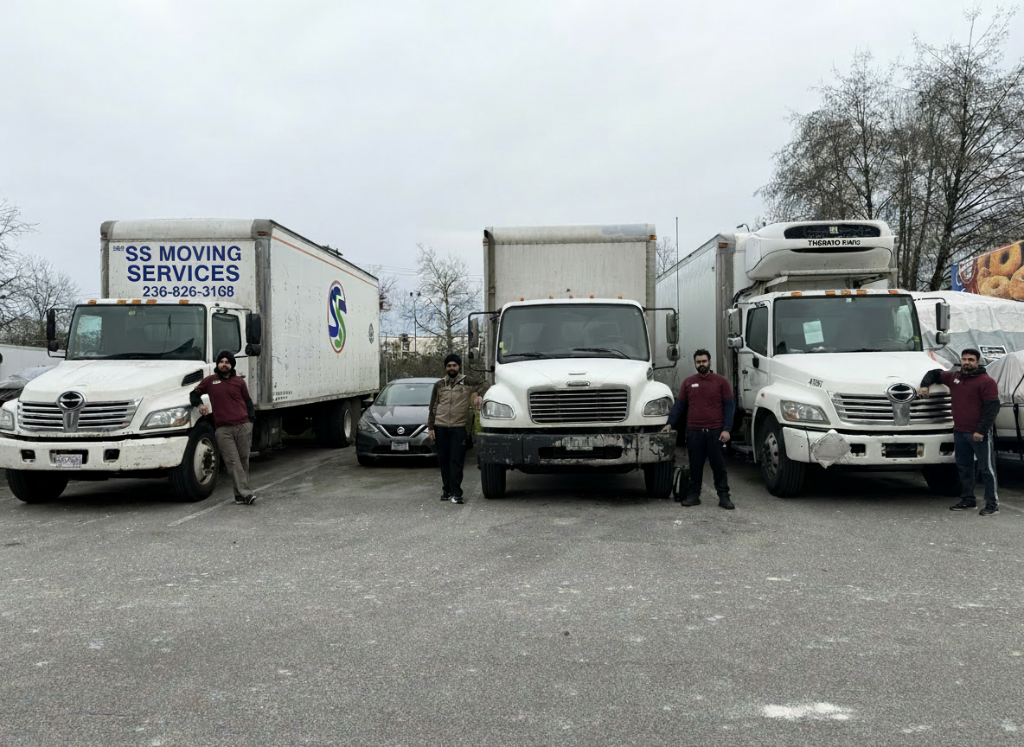
SS Moving Services offers flat-rate quotes that cover the crew, the truck, furniture blankets, and loading/unloading — no mileage surprises. For a typical 1-bedroom apartment move within the Lower Mainland, you get a fixed price upfront, a 2-person crew, and full insurance coverage.
Call (236) 826-3168 for a free flat-rate quote — usually back within 30 minutes.
The Step-by-Step Car-Free Move Plan
2 weeks out
- Book the freight elevator at both buildings (if either has one). Vancouver condos almost always require this, and the slots fill up.
- Get your quote. If you're hiring a mover, lock in the date now — month-end weekends book first.
- Start purging. The less you move, the cheaper and easier it is. Donate to the Salvation Army or Value Village.
1 week out
- Pack everything. Use uniform box sizes for easy stacking. Label every box with its destination room.
- Disassemble furniture. Bag and tape hardware to each piece.
- Reserve your method. Cargo van, cargo bike, or confirm your mover.
Move day
- Load heavy items first, light and fragile items last.
- Take a photo of the empty unit before you hand over keys — proof you left it clean.
- Do a final walkthrough — check closets, the balcony, the parking stall, and the storage locker (the most-forgotten spots in Vancouver apartments).
Vancouver-Specific Tips for a Car-Free Move
- Parking permits matter. Even without a car, your mover's truck needs a loading zone. In Vancouver, you can apply for a temporary no-stopping permit through the City of Vancouver parking services — ask your mover to handle this, or apply yourself at least 3 business days ahead.
- Strata move-out deposits. Many Vancouver condos charge a $200–500 move-out deposit, refundable if there's no damage. Budget for this upfront.
- The SeaBus counts as transit. Moving from North Vancouver to downtown? The SeaBus connects Lonsdale Quay to Waterfront in 12 minutes — but it's passengers only, no cargo. Use it for a pre-move scouting trip, not for boxes.
- Rain is a factor. Vancouver averages 160+ rainy days a year. If you're doing any part of the move yourself, have tarps and plastic wrap ready — see our guide to moving in Vancouver's rainy season.
Quick Comparison: Which Method Fits Your Move?
| Your situation | Best option | Rough cost | |---|---|---| | Studio, boxes only, under 5 km | Cargo bike + transit | $30–80 | | 1-bedroom with some furniture, under 10 km | Car-share cargo van + friends | $120–180 | | 1-bedroom+ with real furniture, any distance | Professional flat-rate mover | $250–450 | | 2+ bedroom or house | Professional mover (full service) | $450+ |
The Bottom Line
Moving without a car in Vancouver isn't just possible — it's often the smarter choice. The city's transit network, cargo bike options, and short-distance moving services give you flexibility that car owners don't have. The trick is being honest about your load: if it's just boxes, go DIY. If it involves furniture, stairs, or distance, a flat-rate professional mover is usually the same price and half the stress.
Need a hand? SS Moving Services covers all of Metro Vancouver with flat-rate, fully insured moves. Call (236) 826-3168 or request a free quote — you'll have a price in 30 minutes.